What is Fake News? Let's think about it a bit, 🧐🤓.
The problem is that you and I don't have that much time, and besides, we also think who needs to fix it.
But on the other hand, people who are degrading the society are using it for their own interests by selling a lot of money, so I think it is very important for the development of the future youth to be vigilant and take it seriously.
Actually, fake news is not new. Because as long as there is news, there will always be misinformation, intentional and unintentional.
The heyday (or fall) of fake news was in the early 20th century, when a single sale figure in the Yellow Pages in 1895 wasАНУ, Испани хоёрыг дайтахад хүргэсэн гэнэ.
Misinformation and bad journalism have always existed throughout history, but in the age of social media, the situation is only getting worse. For example,Pew судалгааны төвийн саяхан хийсэн судалгаагаарfound that Americans see fake news and misinformation as a bigger problem than racism, illegal immigration and terrorism.
But why is fake news such a big problem? Many people agree that fake news is wrong, but why do they read it, share it, and promote it? The reason is that fake news is not only misleading in terms of content, but also plays on our biases and perceptions. As long as there is news, there will be misinformation, both intentional and unintentional.
There’s nothing new about fake news. For as long as there has been news, there has been misinformation, both deliberate and unintentional.
Problem 1: Mode of distribution
The most common way to spread fake news is through social media. This form of personal communication is not only incredibly fast, but also based on trust between people.
Most of the time, we are friends with people we like and trust to a certain extent on social media. Therefore, it is safe for us to trust and tend to trust the information shared there. Simply put, fake news uses our trust in our friends and family to get us to believe and trust them,🤗.
Их Британид хийсэн нэгэн судалгаандOne in six participants admitted that they believed everything their friends shared on social media. According to the same study, people who believe that information on Facebook is more reliable than real experts are the same size, 😅😂.
In short, fake news relies on direct communication and trust in friends and family who encourage you to put aside your doubts and not scrutinize. It's not super fast, but it's incredibly reliable, 😜.
Problem 2: Fake news reinforces our biases
Social media supports fake news on another level. We spend most of our time communicating with our online contacts. The result is combined with algorithms that deliver content that you likeсошиал медиа хөөсөн бөмбөлөгwill be called
It's oursхувийн үзэл бодлыгensures that we're getting only the filtered, enhanced news we need. In short: we don't like to be confused, and we choose social media mainly because it reduces the frequency with which we have to deal with information in our brain-driven mind.
In other words, if someone comes across fake news on social media that matches their opinion, they will reinforce their opinion and be confident that they will not be judged if it contradicts their opinion. This makes it easy to accept and believe the news and further spread it in a chain reaction.
Problem 3: Articles
In addition to reinforcing our biases, fake news exploits another tendency that is our weakness: misunderstandings about established theories.
In academic research, this is called publication bias. Research leads to null results, i.e. hypothesesбатлаж чадахгүй байгаа судалгаагI think it's because we don't publish. Research has shown that this inconclusive study is just as important as confirming a hypothesis.
Fake news always provides evidence for a claim, even when the evidence is complete. We tend to take a closer look at such results because they are more interesting and less guaranteed,😝.
Problem 4: Lust for sensationalism
After all, most news is pretty simple. City council hearings or tax policy debates can have a huge impact on our lives, but they're boring to watch and read about, right?🤣.
Fake news, on the other hand, is almost always sensational and tells fantastic stories. The stories spread by fake news are simple stories that go from extreme to extreme. In other words, it is exaggerating a relatively mundane event with exaggerated language and misinformation.
The most common way is to stimulate people's emotions and cause them to immediately share and forward the information, not to check it!
Fake news doesn't need a lot of thought, but the problem is that a simple but sensational story doesn't force anyone to think about it seriously. In other words, they attract our attention and force their goals on us. We are also easy to get used to. They are using us only after getting used to it, 😅😂.
Summary
In general, there is no secret formula for fake news, it's just that people are quick to share and spread it. They are simply based on the prejudices that exist within us, causing us to hastily judge what we believe and what we reject. So it's surprisingly easy to find interesting lies that can spread like wildfire.
The only defense against fake news is vigilance. Two very important steps are to investigate the source and take the time to identify fake news before it is broadcast.
Unfortunately, it is almost certainly true that the TRUTH will never be able to match the distortions that use false heroism. The truth is, our brains don't care what they're suffering from, and we often don't want to hear them,😫.
A lie flies at the speed of light, and the truth limps behind it...
How to check Fake News is briefly explained in the picture:
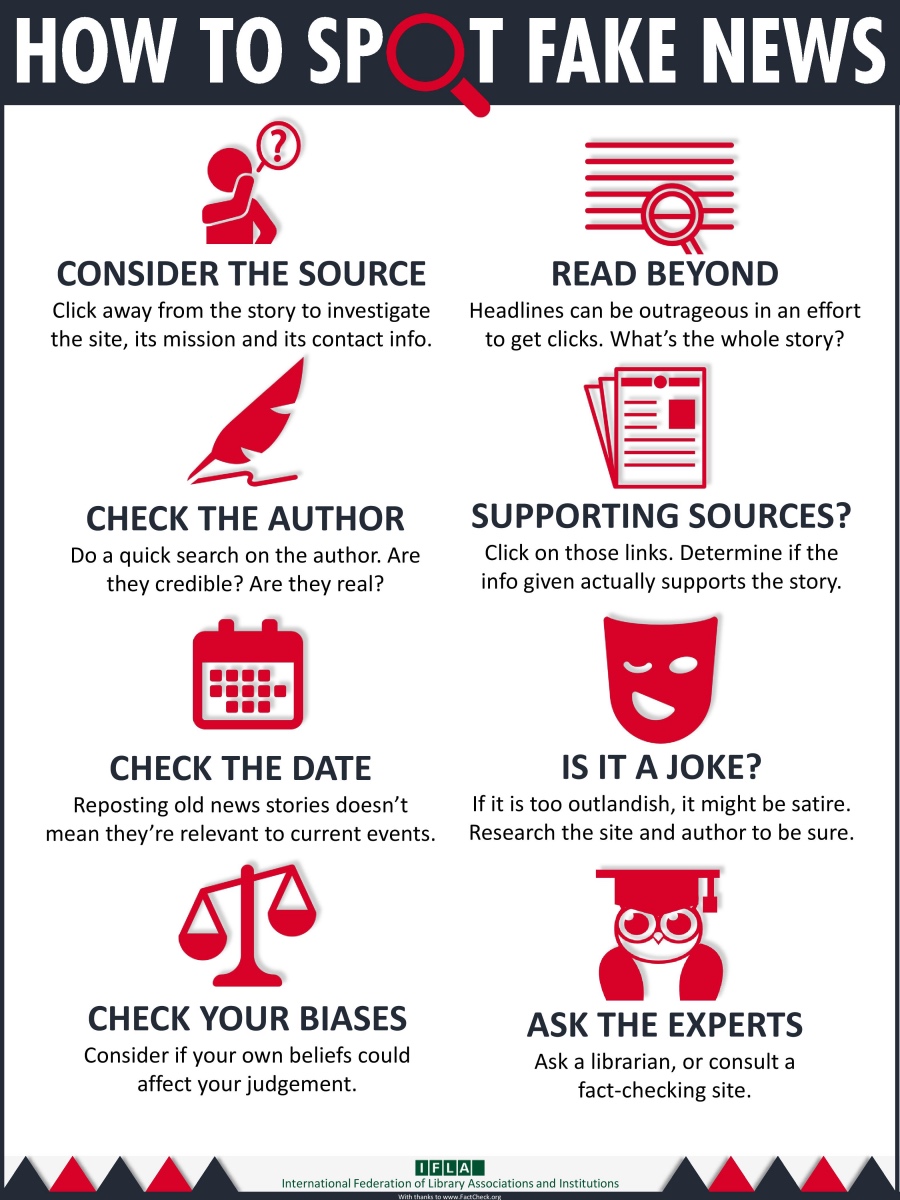
Source:
https://www.kaspersky.com/resource-center/preemptive-safety/how-to-identify-fake-news
https://library.pfeiffer.edu/Fake-News-Worksheet.pdf
https://onlinedegrees.und.edu/masters-cyber-security/tips-for-students-on-how-to-identify-fake-news/
https://www.mindtools.com/pages/article/fake-news.htm
https://www.mdr.de/wissen/erfundene-fakten-psychologie-glauben-wahrheit-fake-news-100.html